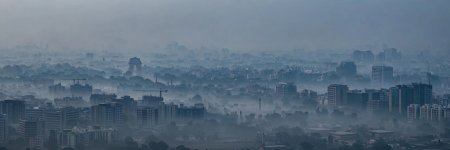
Delhi woke up to its most polluted start to October in four years on Thursday, with the city's average Air Quality Index settling at 166 and falling into the "moderate" category. The reading comes from Central Pollution Control Board data and marks the worst October 1 for the national capital since 2022, according to an analysis by the Centre for Research on Energy and Clean Air.
The AQI of 166 sits in the moderate band (101 to 200) under CPCB classification. The last time Delhi recorded a higher AQI on October 1 was in 2022, when the index stood at 186, also in the moderate category.
Most stations in 'moderate', five hit 'poor'
Of Delhi's 44 monitoring stations, 37 recorded "moderate" air quality while five slipped into the "poor" category and two logged "satisfactory" readings, CPCB data showed.
Among the stations in the "poor" bracket were Dwarka Sector 8 at 214, IIT Delhi at 248, Jahangirpuri at 218 and Narela at 205 — all readings that cross the 201-to-300 poor threshold.
Weak winds and stubble fires behind the dip
The deterioration follows a relatively cleaner September. Delhi recorded a monthly average AQI of 102 in September 2026 — the lowest September average in five years, according to the Ministry of Environment, Forest and Climate Change. City readings had hovered near 100 after weekend rain before climbing to 129 on Wednesday.
The Air Quality Early Warning System attributes the current build-up to weak ventilation: a ventilation index below 6,000 square metres per second combined with average wind speeds under 10 kmph is unfavourable for dispersing pollutants, allowing them to accumulate near the surface.
Stubble burning is also picking up. The Indian Agricultural Research Institute recorded four farm-fire incidents in Punjab, five in Uttar Pradesh and 14 in Madhya Pradesh on Thursday, taking the September 15 to October 1 tally to 137 incidents. Delhi itself reported one such incident on September 19.
Forecast: moderate air for the next few days
The Early Warning System expects Delhi's air quality to stay in the "moderate" category from October 2 to 4, and to hover between "moderate" and "satisfactory" over the following six days. With the monsoon withdrawing and farm fires rising, the capital's smog season appears to be underway.
Sources:
Times Now, News18
The AQI of 166 sits in the moderate band (101 to 200) under CPCB classification. The last time Delhi recorded a higher AQI on October 1 was in 2022, when the index stood at 186, also in the moderate category.
Most stations in 'moderate', five hit 'poor'
Of Delhi's 44 monitoring stations, 37 recorded "moderate" air quality while five slipped into the "poor" category and two logged "satisfactory" readings, CPCB data showed.
Among the stations in the "poor" bracket were Dwarka Sector 8 at 214, IIT Delhi at 248, Jahangirpuri at 218 and Narela at 205 — all readings that cross the 201-to-300 poor threshold.
Weak winds and stubble fires behind the dip
The deterioration follows a relatively cleaner September. Delhi recorded a monthly average AQI of 102 in September 2026 — the lowest September average in five years, according to the Ministry of Environment, Forest and Climate Change. City readings had hovered near 100 after weekend rain before climbing to 129 on Wednesday.
The Air Quality Early Warning System attributes the current build-up to weak ventilation: a ventilation index below 6,000 square metres per second combined with average wind speeds under 10 kmph is unfavourable for dispersing pollutants, allowing them to accumulate near the surface.
Stubble burning is also picking up. The Indian Agricultural Research Institute recorded four farm-fire incidents in Punjab, five in Uttar Pradesh and 14 in Madhya Pradesh on Thursday, taking the September 15 to October 1 tally to 137 incidents. Delhi itself reported one such incident on September 19.
Forecast: moderate air for the next few days
The Early Warning System expects Delhi's air quality to stay in the "moderate" category from October 2 to 4, and to hover between "moderate" and "satisfactory" over the following six days. With the monsoon withdrawing and farm fires rising, the capital's smog season appears to be underway.
Sources:
Times Now, News18