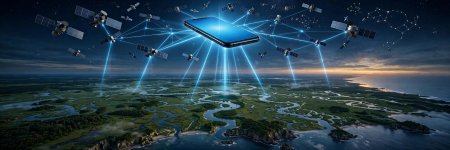
SpaceX's Starlink has switched on its phone-to-satellite mobile service in Bangladesh through a partnership with telecom operator Banglalink, the company's founder Elon Musk announced on October 8. The launch makes Bangladesh one of the first markets where customers can connect ordinary 4G phones directly to Starlink satellites when normal tower signals are unavailable.
The company posted on X that millions of customers can now message over apps, share location and stay connected on compatible phones in cellular dead zones. SpaceX vice president Stephanie Bednarek said the technology provides an additional layer of connectivity in dead zones so coastal communities, remote businesses, families and travellers can stay in touch wherever they are.
How it works
Unlike the dish-based broadband that Starlink launched in Bangladesh last year, Starlink Mobile needs no dish. A compatible 4G phone with a clear view of the sky and a Banglalink SIM is enough to link directly to the satellites when there is no normal tower signal. The service is bundled with Banglalink rather than sold as a separate product.
The company positions it as a backup layer for dead zones such as seas, remote islands, coasts, hill tracts and outages during cyclones, floods or power cuts — not as full broadband.
Contrast with India
In India, Starlink is still awaiting its licence. The dish-based service got its operating licence from Bangladesh's telecom regulator in April 2025 and launched in May; the regulator reported 3,469 subscribers as of January 2026. In India, security compliance for the licensees is still under way, and the company is yet to receive spectrum assignment. Musk has said Starlink in India would enable high-speed, affordable internet connectivity for those who cannot afford current prices or have no connection at all.
Sources: The Week — Bangladesh gets Starlink Mobile before India
The company posted on X that millions of customers can now message over apps, share location and stay connected on compatible phones in cellular dead zones. SpaceX vice president Stephanie Bednarek said the technology provides an additional layer of connectivity in dead zones so coastal communities, remote businesses, families and travellers can stay in touch wherever they are.
How it works
Unlike the dish-based broadband that Starlink launched in Bangladesh last year, Starlink Mobile needs no dish. A compatible 4G phone with a clear view of the sky and a Banglalink SIM is enough to link directly to the satellites when there is no normal tower signal. The service is bundled with Banglalink rather than sold as a separate product.
The company positions it as a backup layer for dead zones such as seas, remote islands, coasts, hill tracts and outages during cyclones, floods or power cuts — not as full broadband.
Contrast with India
In India, Starlink is still awaiting its licence. The dish-based service got its operating licence from Bangladesh's telecom regulator in April 2025 and launched in May; the regulator reported 3,469 subscribers as of January 2026. In India, security compliance for the licensees is still under way, and the company is yet to receive spectrum assignment. Musk has said Starlink in India would enable high-speed, affordable internet connectivity for those who cannot afford current prices or have no connection at all.
Sources: The Week — Bangladesh gets Starlink Mobile before India